
The Best Induction Cookware: A Buyer’s Guide for Real Kitchens
Most of us inherit our cookware decisions. A hand-me-down pot from a parent, a roommate’s stray skillet, a wedding registry built around what someone thought we’d need. Then you switch to induction, and suddenly half of it stops working. You reach for that trustworthy aluminium sauté pan you’ve used forever, set it on the burner, and… nothing happens.
Here’s the secret to navigating the switch to induction: quantity matters far less than quality. A few intentionally made pieces will always outperform a bulky 14-piece set—especially on induction, where pan construction directly dictates how evenly your food cooks.
Consider this your practical buyer’s guide. We’ll cover how to test your current lineup, what to look for when shopping, our favorite category-by-category picks, and how to avoid common pitfalls like buzzing, warping, and cold spots.
How to know if your cookware works on induction
Induction cooktops don’t heat the burner; they use electromagnetic energy to heat the pan directly. Because of this, your cookware must have a magnetic base.
The fastest check is the magnet test. Grab a fridge magnet and hold it to the bottom of your pan. If it snaps on firmly, your pan is induction compatible. If it slides off or barely clings, it’s probably not.
Beyond the quick magnet test, here is a simple three-step check for any pan:
Look for the symbol. Most induction-ready pieces feature a small stamp on the base resembling a coiled spring—the international marker for induction compatibility.
Test the pull. A strong, immediate magnetic stick means there is enough ferrous metal in the base to conduct heat quickly and efficiently.
Check the base for flatness. Hold the pan at eye level and look across the bottom. It should be completely flat, not bowed, and feel substantial in your hand. Thin, lightweight pans tend to buzz, warp, and heat unevenly under induction’s rapid temperature shifts.
Materials that work on induction:
Enameled cast iron
Bare cast iron
Magnetic stainless steel (often labelled “induction-ready,” typically with an 18/0 stainless exterior)
Carbon steel
Aluminium-based pans built over a magnetic base (e.g. Our Place Ceramic nonstick pans)
Our Titanium Pro cookware (since it’s built with a magnetic stainless steel exterior)
Materials that don’t work (at least without an adapter plate):
100% aluminium
Pure copper (clad copper-core pans with a magnetic exterior are the exception)
Glass and ceramic stoneware
Non-magnetic 18/10 stainless steel
A quick note on performance: A pan can be labelled “induction-compatible” and still underperform if the magnetic layer is too thin. Loud buzzing or a burner that repeatedly loses contact are signs the base lacks structure. When in doubt, lean towards heavier, multi-layer pieces.
Why make the switch to induction in the first place? According to data from the Electric Power Research Institute (EPRI), induction cooktops transfer roughly 85% of their energy directly to the pan, compared to about 74% for electric coil and just 40% for gas. It’s faster, safer, and remarkably energy-efficient, provided you have the right tools.
What to look for in the best induction cookware
When buying induction cookware, look beyond the compatibility sticker. The pieces that actually perform have three things in common: a thick, flat base, a substantial overall weight, and a cooking surface you’d be comfortable using every day.
Base thickness. Induction transfers heat through direct contact with the magnetic layer. A thin base means uneven heat, hot spots, and pans that warp the first time you hit high power. Thick fully-clad construction or a heavy bonded disc bottom will both work. Anything that feels flimsy, you want to avoid.
Flatness. Induction needs full contact. A pan with even a slight bow won’t seat properly on the cooktop and will heat inconsistently. Cast iron and high-quality pans are flat by design. Cheaper stamped pans often aren’t.
Weight. A heavier pan stays put on the cooktop, holds heat steadily, and resists warping. The flip side: very heavy cookware can scratch the glass surface if you slide it.
Cooking surface. This is the part of the buying decision the spec sheets tend to skip. Induction’s speed and precision matter less if the surface inside the pan isn’t one you trust to cook food on every day. Look for a coating, or no coating, that’s made without PFAS (including PTFEs and PFOAs), lead, and cadmium. Heat is faster on induction than on gas or electric, which means whatever is between your food and the pan is hit harder, faster.
The best induction cookware: our top picks by category
Most buying guides try to sell you a mega-set of twelve specialised pans you’ll never use. We believe in doing more with less: choosing versatile, thoughtfully designed pieces that handle real, everyday cooking.
Here are the essentials worth investing in.
Our top choice: Best all-in-one for induction
If you’re looking for a robust induction-compatible pan, our Titanium Always Pan® Pro will have the best performance on induction stovetops thanks to its NoCo® titanium nonstick technology that has enhanced conductivity with induction plates.
This everyday nonstick frying pan covers the majority of weekly cooking: eggs, sautéed vegetables, weeknight stir-fries, pan sauces, one-pan dinners. The case for going with one well-built all-in-one piece instead of a sprawling set is strongest on induction, where pan quality directly affects performance.
Our Titanium Always Pan Pro is built for this. Featuring our exclusive NoCo® titanium nonstick technology made without PFAS (including PTFEs and PFOAs), lead, and cadmium, it’s designed to replace 10 pieces of cookware and is compatible with all cooktops, including induction.
It’s also amazing for searing. For steaks, crispy-skin fish, smashburgers, or anything that benefits from really hot, fast contact with the pan, you want a surface designed to take that kind of heat.
With a stainless steel exterior, aluminium core, and titanium interior, our Titanium Always Pan® Pro performs exceedingly well with induction cooktops. It provides both the searing power of stainless steel and the versatile convenience of a nonstick pan.
With our NoCo® nonstick technology, the Titanium Always Pan Pro is the first pan with a nonstick experience that is constructed, not coated, heat-safe up to 1,000°F (535°C), and compatible with all cooktops, including induction.

Best for soups, stocks, and braises
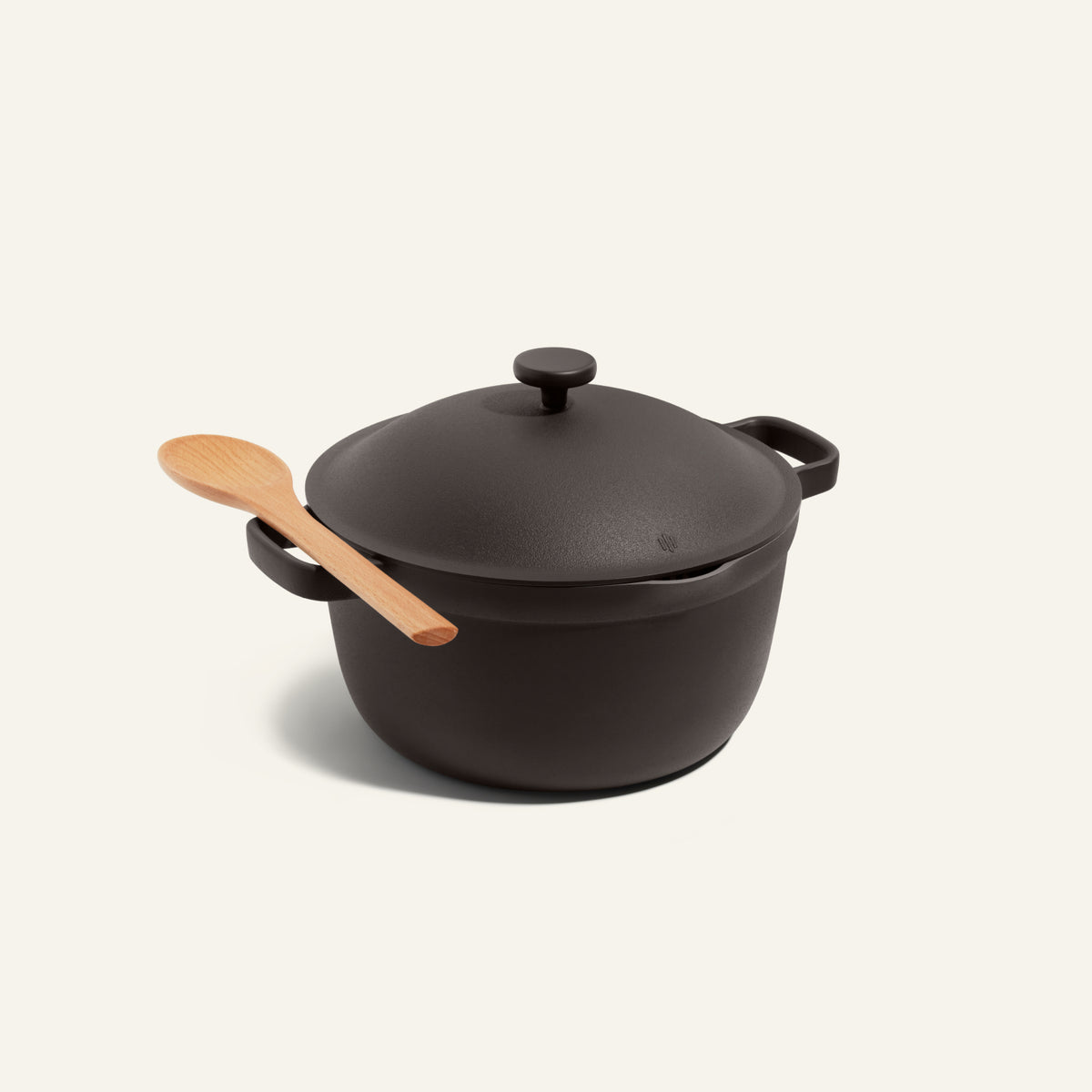
Induction excels at boiling water in record time and holding precise simmer temperatures. A roomy, high-walled pot lets you take full advantage of that responsiveness.
The Perfect Pot® pairs that fast-heating induction base with lightweight durability. It transitions seamlessly from boiling pasta to slow-simmering a Sunday sauce, complete with a built-in strainer lid and pour spouts so you dirty fewer dishes.
Best for low-and-slow braises
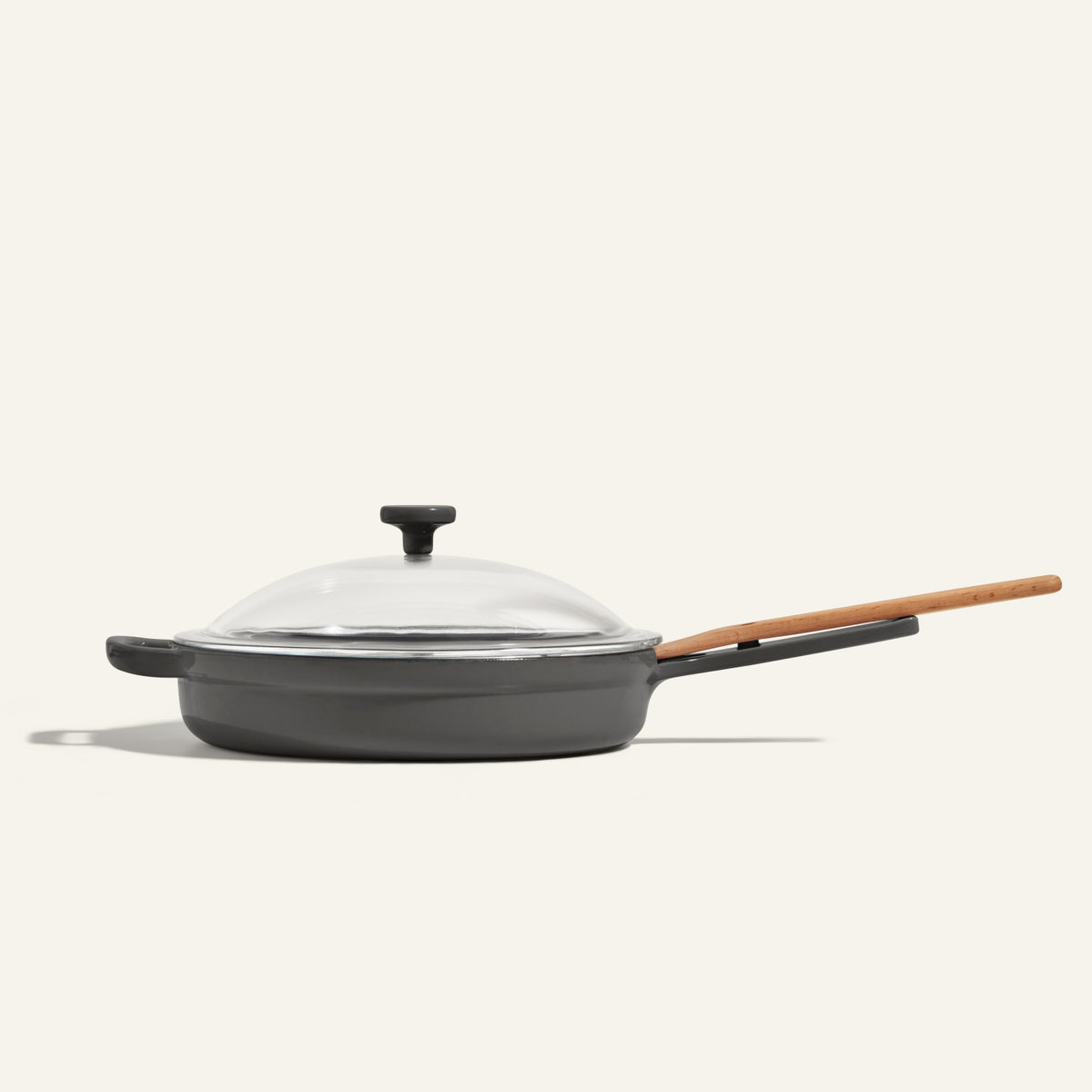
Enameled cast iron is an induction superpower. Cast iron holds onto thermal energy better than almost any other material, making it ideal for braised short ribs, slow-cooked beans, and hearty stews.
Our Cast Iron Always Pan® offers the steady heat retention of traditional Dutch ovens in a wide, versatile shape. Its flat, smooth base sits flush against induction glass, while the black matte enamel interior builds a beautiful patina over time, with no tedious seasoning required.
💡Pro Tip: Always preheat cast iron gradually on induction. Because induction heats so quickly, jumping straight to high power can thermal-shock the iron or burn your food before the pan finishes warming up.
Materials comparison at a glance
Each material has its own behaviour on induction. Here’s how they compare on heat response, durability, care, and what they’re best suited for.
Material |
Heat response on induction |
Best for |
Care |
Notes |
Titanium Pro line (titanium interior, aluminium core, stainless steel exterior) |
Better heat retention |
Searing, high-heat finishing, metal-utensil cooking |
Dishwasher safe |
A constructed surface, not a coating |
Ceramic nonstick (over magnetic base) |
Fast, even |
Eggs, weekday cooking, simmering |
Hand wash, low-to-medium heat |
More delicate and not dishwasher safe. |
Enameled cast iron |
Slow to heat, exceptional retention |
Braises, soups, stews |
Hand wash |
Heavy. Lift, don’t slide |
Magnetic stainless steel (clad or disc) |
Better heat retention |
Searing, deglazing, sauces |
Dishwasher safe |
Not naturally nonstick |
Carbon steel |
Very fast |
Stir-fries, woks, high-heat searing |
Hand wash, requires seasoning |
Sensitive to acidic foods |
The bottom line
Induction rewards cookware that is heavy, flat, and thoughtfully constructed. Rather than buying a cheap, oversized boxed set, focus on building a lean kitchen system with pieces you’ll love using every single day.
An everyday nonstick skillet, a versatile deep pot, a high-heat sear pan, and a cast iron essential will carry you through virtually any recipe.
New to induction? Explore our fully compatible Non-Toxic Cookware Collection.
Want to learn more about kitchen safety? Check out our deep dives below.


